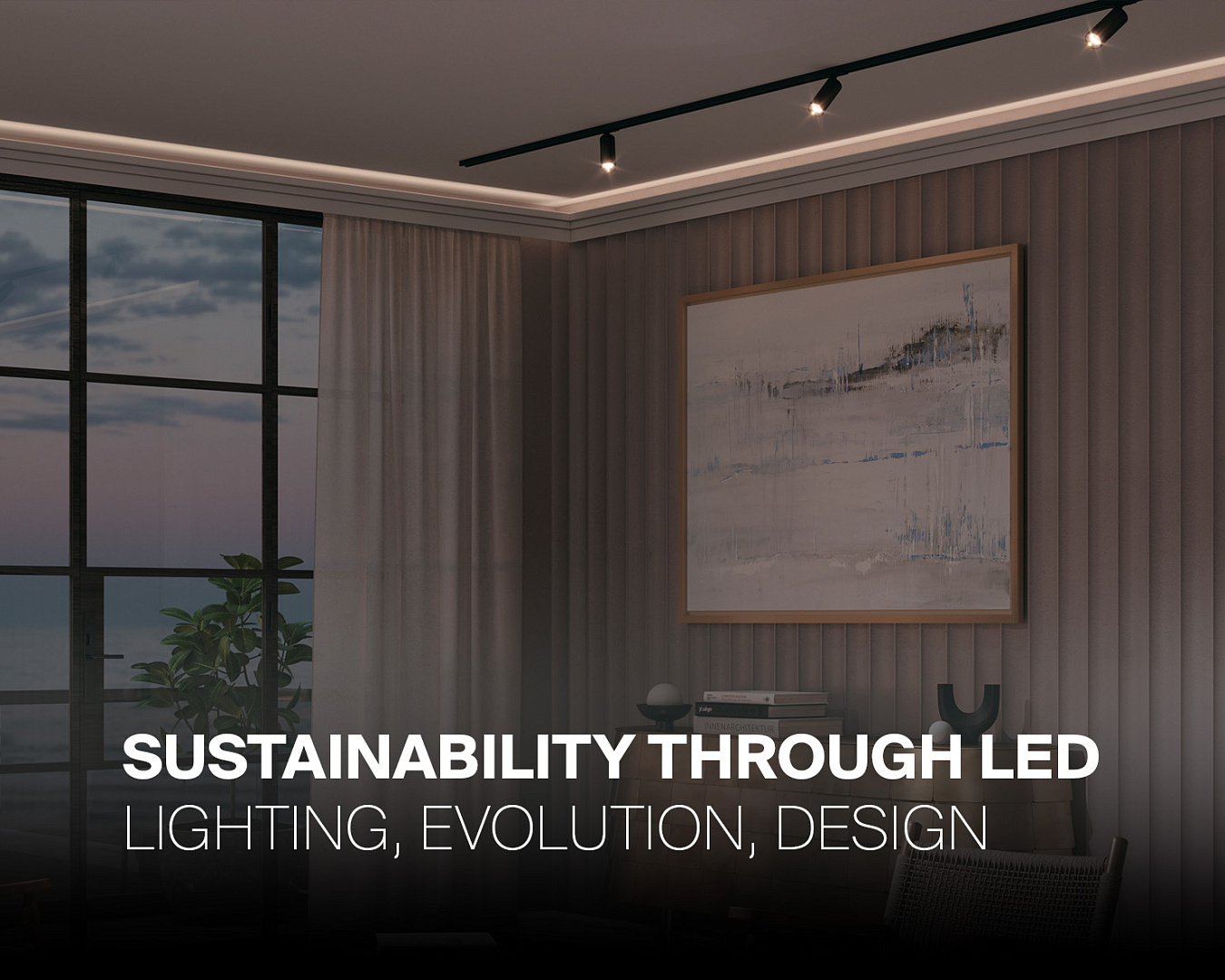
As humans, we often describe the arrival of a great idea as a ‘lightbulb moment’ - that instant transformation fr om helpless darkness to illuminating clarity. But whilst a great idea is always a great idea, these days the bulb itself is a rather different – and very much more sustainable – affair than it previously was.
This is critical, because according to the United Nations Climate Change unit, electricity for lighting accounts for approximately and 5 per cent of worldwide greenhouse gas (GHG) emissions.
A global transition to efficient lighting would reduce these emissions by over one-third. And at the forefront of this sustainability evolution is a tiny, three-letter acronym: LED.
Here’s why Maytoni has switched to LED bulbs for over 50% of the luminaires we design and produce – and what a sustainable lighting future looks like.
LEDs: the science behind the sustainability
Officially, LED stands for light emitting diode, and one of the fascinating things about them (and their high sustainability score) is that they’re actually a form of microchip, or semiconductor.
If this seems more like something you’d find in a PC or smartphone, rather than in a light bulb, it’s worth knowing that these chips are deliberately loaded (or ‘doped’) with impurities, which help turn the electricity flowing into them into light coming out, and control characteristics like colour, intensity, and so on.
Because of this method of operation, what they don’t produce – unlike the old-fashioned incandescent bulbs – is heat.
No heat, no energy wastage. No energy wasted, far less energy used. In fact, LED bulbs are up to 90% more energy-efficient than earlier types.
That’s a lot of electricity, expense, and emissions saved.
Longer life than the figures suggest
And though LED bulbs are estimated to last around 25 years longer than incandescent varieties – which of course means fewer of them have to be produced to replace those that have reached the end of their life – this figure is in fact very conservative.
Why? Because longevity is measured differently in LED and incandescent bulbs. An incandescent bulb reaches the end of its life when it ‘burns out’. An LED, however, typically doesn’t burn out - it’s judged to be at the end of its life when its brightness diminishes by 30%.
So, whilst an LED bulb might dim over time, it can actually deliver significantly more longevity than it’s often given credit for.
Recycled material and recyclability
But like all innovations, LED bulbs are constantly in the process of being improved upon. This is not so much to do with the light yield, but rather with the sustainability of the manufacturing methods.
In fact, some brands of LED bulb are now made using up to 40% post-consumer recycled (PCR) plastics.
It’s also important to note that – bulbs, strips, even broken Christmas lights!
This is a vast improvement over incandescent bulbs, which contain so little recyclable material that the sustainability impact of the recycling process is worse than simply throwing the bulb away. Learn more about Maytoni’s commitment to the sustainable product lifecycle.
Shining a light on increased sustainability
But the sustainability potential of LEDs doesn’t stop there.
Because of the way they transform current into light, LEDs bulbs lend themselves particularly well to sensitive control.
This means that they work well with systems, which combine electrical and natural light to reduce overall energy consumption — the same principle behind solar-powered LED outdoor lighting.
LED bulbs also work well with both remote and smart lighting systems, so their already low energy consumption can be reduced further by intelligently switching them on and off only as needed, through sensors, and control apps on tablets and smartphones.
From an interior design perspective, too, LEDs tend to function more sustainably, because they can achieve aesthetically varied effects for the manufacture of fewer bulbs and less hardware.
For example, a single LED bulb containing red, blue, and green diodes can deliver some 16 million different shades of coloured light, depending on the intensity of each diode – and this can be closely controlled.
The days of having to combine different-coloured incandescent bulbs – each one with a much shorter lifespan that an LED bulb – to achieve multicoloured lighting effects are long gone.
And the lighting waste generated by them has gone too.
LEDs: part of our sustainability strategy
At Maytoni, we’re constantly developing our , from ceiling lamps, to downlighters, pendant lamps, track lighting, luminaires, and more.
And this is no isolated initiative. It fits closely with our wider sustainably strategy.
Our components – stainless steel, aluminium, glass - are recyclable at end of life, whether in a stainless steel pendant lamp, an aluminum wall luminaire, or a glass table lamp, and we actively encourage the repurposing of our lights wh ere possible, giving them second or third lives in a new home.
We also work with our suppliers to develop sustainable practices across the entire manufacturing and distribution process.
But sustainability is also about quality, durability, and timelessness. The longer something lasts – and the longer it stays beautiful – the less likely it is to need replacing.
Put simply, we create lighting with longevity, to keep it out of landfill – and our commitment to LED means the bulbs do their bit for sustainability too.