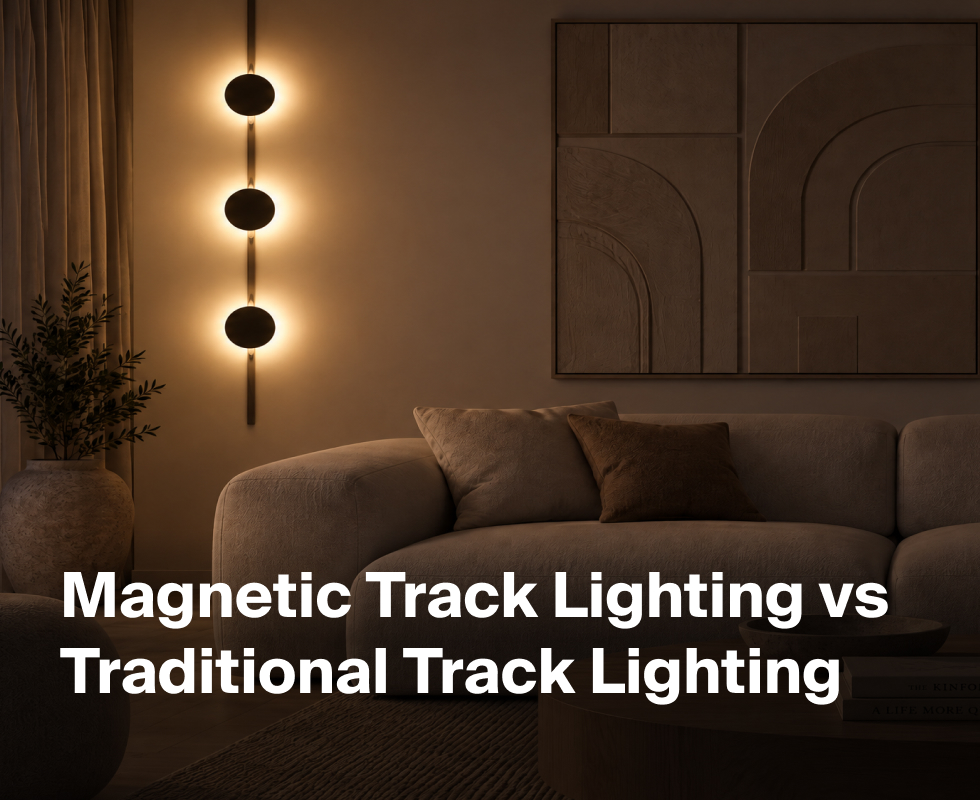
Track lighting offers a flexible way to position and aim luminaires, making it useful in retail, hospitality, galleries and adaptable interiors. Magnetic track lighting and traditional track lighting can look similar in a finished space, but the systems differ in construction, electrical design and product compatibility. The right choice depends on the project—not on the system name alone.
How the systems work
Traditional track systems use a powered track with luminaires that connect through compatible adapters. Depending on the system, luminaires can typically be repositioned along the track and aimed at different targets. Maytoni's single-phase UNITY and three-phase TRINITY are examples of traditional track-system categories; components from different systems should not be assumed to work together.
Magnetic track lighting uses magnetic attachment to connect compatible luminaires to a track. Maytoni's EXILITY magnetic track system is one catalogue example; the Points EXILITY DALI 2 luminaire is a product within that system. Many architectural magnetic systems operate at low voltage, but ratings and system designs vary. The track, power supply, adapters and luminaires must be selected as a compatible set and installed according to the manufacturer's instructions.
Compare flexibility and appearance
- Installation. Requires a compatible magnetic track, supply arrangement and approved mounting details. Uses a matched powered track and mechanical/electrical luminaire adapter; phase configuration matters.
- Repositioning. Compatible modules may be moved or changed, subject to the system instructions. Compatible heads can often be repositioned and aimed, subject to system instructions.
- Compatibility. Track, power supply, drivers and luminaires must belong to an approved system. Track, adapters and luminaires must match the specific single- or three-phase system.
- Cost considerations. Compare track, power units, accessories, labour and future module replacement. Compare track, adapters, luminaires, labour and future replacement.
- Typical applications. Integrated interiors, display walls and projects seeking a discreet modular appearance. Retail, galleries and spaces needing adjustable accent lighting.
Product range, electrical configuration, ceiling detail and labour requirements determine the actual outcome.
Check the technical details
- Track dimensions, electrical ratings and permitted installation method.
- Compatibility between track, adapters, luminaires and power supplies.
- Available beam distributions, outputs, colour characteristics and dimming options.
- Maximum loading and any system-specific limitations.
- Applicable safety approvals and installation requirements in the project location.
- Access to drivers, replacement parts and technical support.
Do not combine components based on appearance alone. A system's voltage, current capacity and control method are essential design inputs. The electrical contractor should verify the installation against the manufacturer's technical documentation and local requirements.
Choose for the project lifecycle
Compare initial cost alongside installation, adjustment, maintenance and future availability. Ask the client how often the space may be reconfigured and who will manage the system. A mock-up can help the design team assess glare, beam quality, track visibility and the relationship between the system and the ceiling.