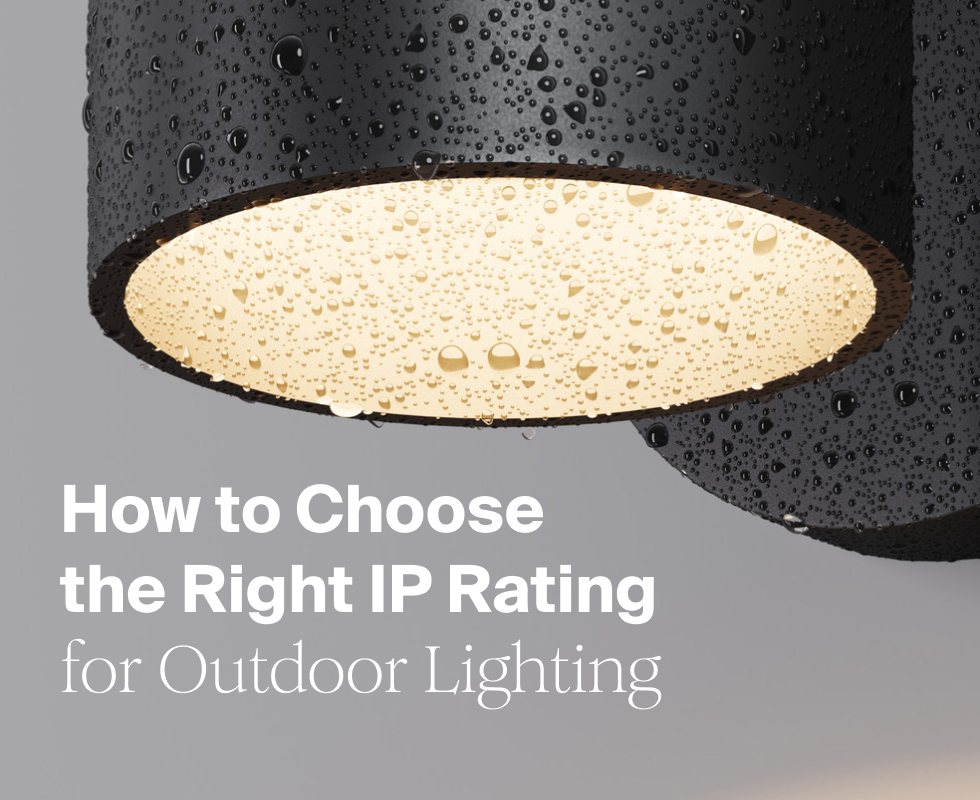
An ingress-protection rating is one useful part of selecting outdoor lighting, but it is not a complete measure of a luminaire's suitability. The right choice depends on the installation location, exposure, mounting details and manufacturer instructions. Always verify the product documentation and local requirements before specifying or installing a luminaire.
What does an IP code mean?
An IP code describes protection provided by an enclosure against access to hazardous parts and the ingress of solid objects and water under specified test conditions. In a two-digit code, the first digit relates to solids and the second to water. The code does not, by itself, guarantee resistance to corrosion, UV exposure, impact, temperature extremes or every real-world weather condition.
IP54 vs IP65
- IP44. Solids: Against solid objects of 1 mm and larger. Water: Against splashing water. May suit certain sheltered uses only where the product and site conditions permit.
- IP54. Solids: Dust-protected: limited ingress permitted without harmful effects. Water: Against splashing water. Not dust-tight; check actual weather exposure and mounting conditions.
- IP65. Solids: Dust-tight. Water: Against water jets. Does not mean submersible, impact-resistant or resistant to high-pressure cleaning.
- IP67. Solids: Dust-tight. Water: Against temporary immersion under prescribed test conditions. Does not automatically imply suitability for water jets or permanent immersion.
The IK rating addresses mechanical impact separately; neither code replaces checks on corrosion, UV, temperature, seals or installation.
The first digit in both IP54 and IP65 indicates a different level of protection against solid particles. The second digit describes water protection under specified test methods. In general terms, IP54 indicates protection against dust ingress that is not entirely prevented and against splashing water; IP65 indicates a dust-tight enclosure and protection against water jets under the relevant test conditions. For product examples, Maytoni lists the Quadra wall luminaire, O143WL-L8TK, as IP54 and the Cottage wall luminaire, O188WL-L8BK, as IP65; use each product's current technical documentation to assess the specific installation.
These descriptions should not be treated as a substitute for product instructions. An IP rating does not mean a luminaire can be submerged, pressure-washed or installed in any position. Installation orientation, cable glands, seals and the condition of the enclosure can affect the protection of the complete assembly.
Match the rating to the exposure
Start by identifying where the luminaire will be installed: under a canopy, on an exposed wall, near the ground, in a sheltered entrance or in an area subject to cleaning. Consider direct rain, wind-driven water, dust, irrigation and the possibility of standing water. For pools, fountains or other demanding environments, follow the applicable specialist standards and manufacturer's guidance rather than extrapolating from a general outdoor rating.
Also check the surrounding conditions. Coastal locations, industrial atmospheres and high-UV environments can require attention to materials and finishes beyond the IP code. Confirm temperature limits and any restrictions on mounting or orientation.
Check the complete installation
A luminaire's rating can be compromised by incorrect installation. Use the specified cable entries and accessories, maintain seals, follow torque instructions where provided, and avoid drilling or modifying the enclosure unless the manufacturer permits it. Contractors should confirm that the complete installed assembly meets project requirements.
Record the exposure assumptions, required rating, product reference and installation method in the specification. Review technical documentation for the exact variant being ordered, since similar-looking products may have different ratings. If there is doubt, ask the manufacturer or supplier for written confirmation.
The right outdoor lighting IP rating is the one supported by the actual site conditions and product documentation—not simply the highest number available. Pair it with suitable materials, correct installation and a maintenance plan.